

THE ACTIVISM
The 2026 Movement Election Map is a free voter guide for people who want to vote with clearer eyes in the midterms.
It doesn’t sell party salvation, it tests candidates race by race against human-rights standards: detention, private confinement, healthcare, land, water, corporate power, and democratic control.
Democrats don’t get automatic moral credit. Republicans don’t get to hide behind branding. Socialists don’t get a pass without a real path to power.
Everybody gets tested.
Oye, mira.
We need to talk.
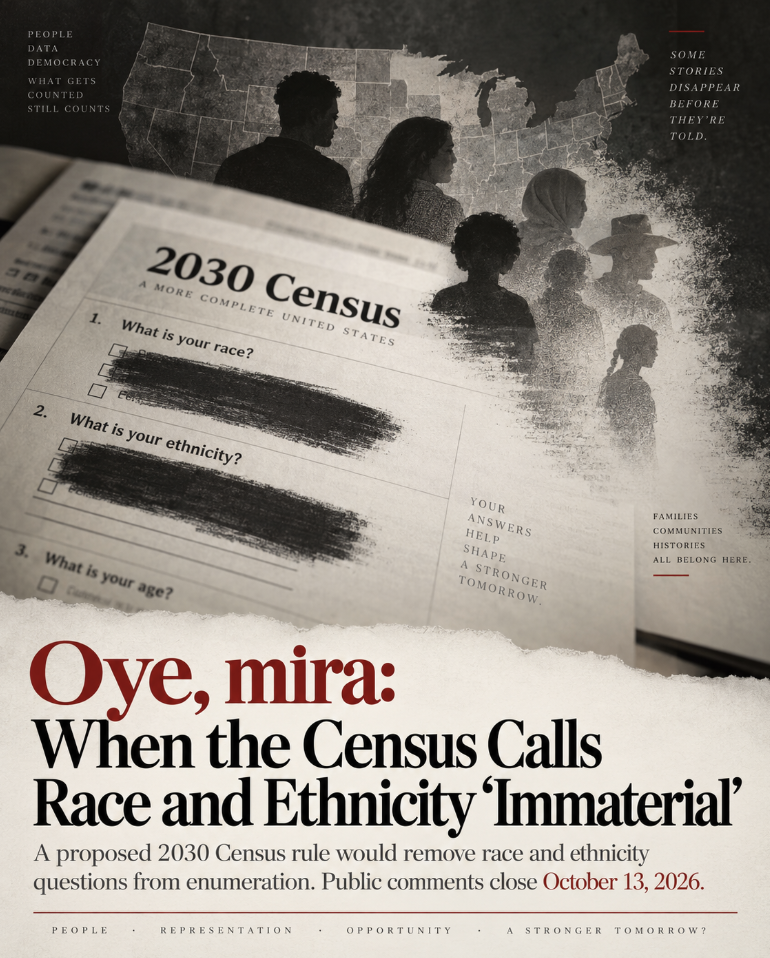
The Trump administration is proposing to remove race and ethnicity questions from the 2030 Census entirely. They are calling our identities "immaterial personal characteristics." Let that land.
This is epistemicide written into federal regulation. You cannot enforce civil rights protections for communities you have erased from the data. You cannot address health disparities you have made statistically invisible. You cannot redistribute resources to people the government has decided do not need to be counted.
They are also proposing to exclude non-citizens without green cards from the apportionment base, which determines congressional representation and billions in federal funding. The Legal Defense Fund is already warning this will directly diminish Black political representation.
This is the oldest colonial playbook in existence. And it requires precision to name correctly.
The colonial instrument was never simply counting or not counting.
It was control of the archive. Spain built the sistema de castas and used it to govern who owned land, who could be enslaved, and who held rights. Britain ran the most obsessive racial counting operation in imperial history, manufacturing caste and religion into rigid legal categories across colonized India that still structure its politics today. Belgium buried the death toll of ten million Congolese people under the paperwork of a private colonial corporation. Italy suppressed the record of chemical warfare and mass civilian slaughter in Libya and Ethiopia. Portugal controlled the archive of what extraction actually cost the people who survived it across Africa and Brazil.
They counted race meticulously when counting served domination. They destroyed or suppressed the record when documentation would have evidenced the crime. Same hand on the ledger, both directions.
Which makes what is happening right now the most legible version of this pattern. This country counted race for 230 years to enforce slavery, segregation, redlining, and exclusion. It is proposing to stop now, precisely when that data is finally being used for remedy instead of control.
Same instrument. Opposite direction. Identical function.
An undocumented crime is a crime that legally did not occur. They know exactly what they are doing.
You have 25 days. Use your voice here.
MODERN-DAY LYNCHINGS:
DEMAND ANSWERS
Black people are being found hanging in the United States, and the deaths are being closed as suicides faster than families can bury their dead.
In February 2026, the civil rights organization JULIAN published The Crimson Record, documenting more than 70 modern-day lynchings across seven Deep South states since 2000 — cases its investigators found had been misclassified through inadequate investigations and faulty autopsies. At least ten more Black people have been found hanging in 2026 alone.
On 10 September 2026, sixty members of Congress, led by Rep. Ayanna Pressley, demanded that the Department of Justice and the FBI open a federal investigation. In Pressley's words: "Inaction by the federal government is tantamount to complicity. This is part of the legacy of racial terror in the United States."
The families are asking for what every family deserves: an independent autopsy, an honest investigation, and the truth.
TASIA FORTUNE — SUPPORT HER FAMILY
Tasia Fortune, 29, a mother of four, was found hanging from a tree behind a vacant house in Jackson, Mississippi on 3 August 2026. Her mother, Christy Spivey, refused the suicide explanation from the start: "She did not do this to herself. I know my daughter."
On 10 September, the Mississippi State Medical Examiner ruled her death a homicide. A man has been arrested and charged; he has pleaded not guilty. Her family still does not know why she was killed, or why she was left hanging from a tree.
Her mother was right. Her family needed the state to believe her.
Give to Tasia's family — organized by her aunt, Etta Avolio, for burial and final arrangements.
THE NAMES FAMILIES ARE STILL FIGHTING FOR
Demartravion "Trey" Reed, 21 — Delta State University, Mississippi, September 2025. Ruled a suicide. His family is still asking for the truth.
Torrance "Tory" Medley, 39 — Milwaukee, Wisconsin, November 2025. His family disputes the ruling and has retained an attorney.
Juliana Nzita, 16 — Charlotte, North Carolina, May 2026. Found eleven days after she went missing. Ruled a suicide. Her family is seeking answers.
To'Nea Nicole Miller, 27 — Miami, Florida, June 2026. Ruled a suicide. Her sister disputes the finding.
Justice Kai James, 21 — Albany, Georgia, June 2026. Ruled a suicide. His family knew of no mental-health struggles.
Nolan Wells — Mississippi, July 2026. Cause and manner of death undetermined. His parents are still waiting.
Say their names. Follow their cases. Capital B's reporting tracks them.
WHAT WE DO — WITHOUT WAITING FOR PERMISSION
1. Fund the truth directly. An independent autopsy is the first thing families ask for and the first thing they're told they can't afford. Give to families, and to the investigators who commission independent autopsies when the state won't. Tasia Fortune's family · JULIAN
2. Build the record they won't. JULIAN's The Crimson Record is a counter-archive: 70+ cases the official record called something else. If you know of a case, report it. Read it. Share it. Report a case to JULIAN
3. Watch the courtroom. Tasia Fortune's case now has a defendant. Follow the court dates in Jackson, Mississippi. Show up if you can, amplify if you can't. Accountability that is watched behaves differently from accountability that isn't.
4. Take it past Washington. The NAACP Legal Defense Fund has taken these deaths to the United Nations, where the U.S. government does not control the outcome. NAACP LDF · What LDF is demanding
5. Refuse the silence. Every one of these cases was closed quickly and quietly. Keep them open in public. Say their names.
ICE IN YOUR COMMUNITY:
REPORT IT, VERIFY IT,
KNOW YOUR RIGHTS
A rumor moves faster than a raid. Unverified sightings scatter people, keep children home from school, and empty the block before anything has been confirmed — and when the alarm turns out to be wrong, the next real one gets ignored.
So call the networks that verify before they alert, and that connect families to lawyers when it is real.
Report ICE or CBP activity
MigraWatch — national — 1-844-363-1423. Run by United We Dream. A nationwide line to report ICE and CBP activity and get support.
Colorado Rapid Response Network — 1-844-864-8341. Press 1 for an incident happening now. Press 2 for something that already happened.
Colorado Immigrant Rights Coalition
Someone detained? The National Immigration Detention Hotline from Freedom for Immigrants can be dialed from inside many detention centers free of charge by pressing 9233#, weekdays.
Find the hotline for your state
Most states have their own rapid response network, staffed by people who know the local jails, the local judges, and the local lawyers.
National directory of immigration hotlines — NNIRR
Rapid response hotlines by state — Latinx Therapy
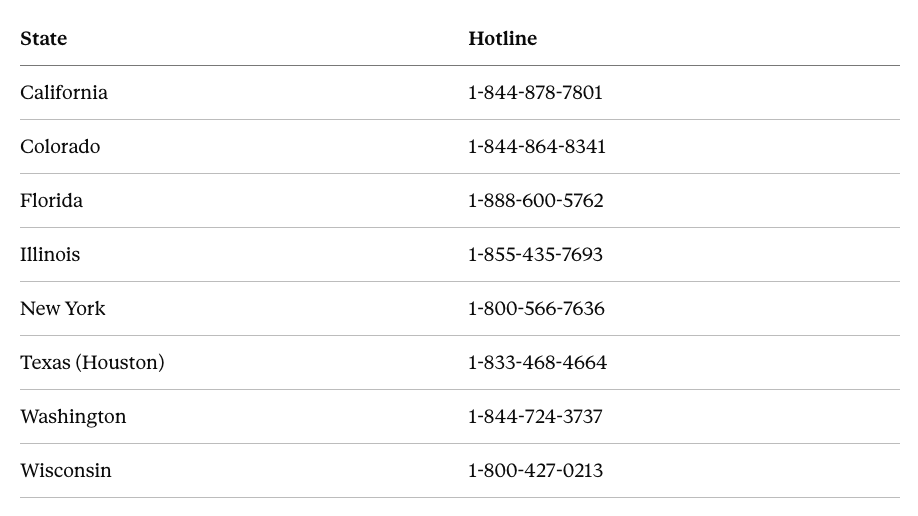
A few of the statewide lines:
Know your rights — before you need them
Red Cards / Tarjetas Rojas, Immigrant Legal Resource Center
free, printable cards in more than a dozen languages that state your rights and can be handed through a closed door without saying a word. Print them. Keep them in your wallet, your glovebox, and by your door.
Know Your Rights: ACLU — what to do if you are stopped, at home, at work, or in a car.
These rights belong to everyone in the United States, whatever their status.
If you witness it
Document from a safe distance. Do not interfere. Record what you saw — time, place, how many agents, what vehicles, what they said, whether they showed a warrant — and call the hotline for your state. That record is what lawyers use.
Save these numbers in your phone now, and share them with your neighbors. The moment you need them is the moment you cannot look them up.
DATA CENTER TRUTHS
THE TRUTH ABOUT WATER
We tell the truth even when it's inconvenient. A movement built on exaggeration hands its opponents the win.
Data centers do use real water. In 2023, U.S. data centers consumed about 17 billion gallons directly for cooling, and roughly 211 billion more indirectly, through the power plants that feed them.
Environmental Law Institute, citing Lawrence Berkeley National Laboratory
But they are not the country's biggest water problem. U.S. golf courses applied about 531 billion gallons in 2024 — roughly 30 times what data centers used directly, and more than twice their total even counting power generation. GCSAA
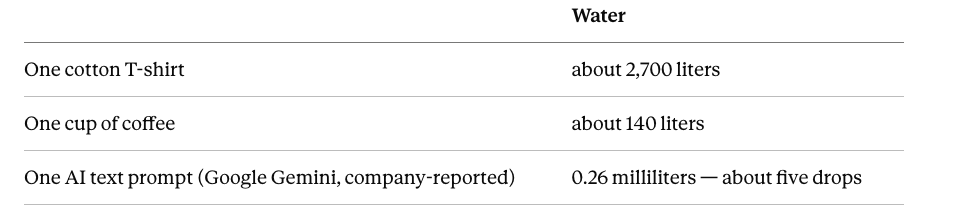
Per use, the gap is even larger:
T-shirt · Coffee — World Economic Forum · Gemini — Data Center Dynamics
Google's figure leaves out the water used to generate its electricity and to train the model, and independent researchers say it undercounts. But even if it were off by a factor of a hundred, one T-shirt would still equal about 100,000 AI prompts, and one cup of coffee more than 5,000. The T-shirt and coffee numbers are full lifecycle footprints, most of it water used to grow the cotton and the beans, so compare the scale, not the decimal.
And AI isn't the only thing in the building. Data centers hold the whole internet: your streaming, your shopping, your photos, your email. Netflix streams from Amazon's cloud. AI is what's driving the new construction boom, data centers used 4.4% of U.S. electricity in 2023 and could use up to 12% by 2028, but it isn't the only thing drinking.
Where water is a crisis is location.
About two-thirds of the data centers built since 2022 sit in water-stressed regions. Environmental Law Institute A data center drawing from an aquifer in drought is a local emergency, even when the national total is small. So the real question is never how much water does AI use. It's whose water, in whose drought.
WHERE THE REAL THEFT IS: YOUR ELECTRIC BILL
This is the part they'd rather you spend your time arguing about water instead of.
The bill.
Across the PJM grid, 13 states and Washington, D.C., the price utilities pay to guarantee power supply jumped more than ninefold in a single year, from $28.92 to $269.92 per megawatt-day. The Institute for Energy Economics and Financial Analysis found data centers caused 63% of that increase: $9.3 billion, recovered from ordinary customers. By mid-2025, monthly bills were up about $21 in D.C., $18 in western Maryland, and $16 in Ohio. IEEFA
How they do it.
Harvard Law School's Electricity Law Initiative traced the mechanism: utilities spread the cost of new power plants and transmission lines built for data centers across everyone's rates, and sign discounted, often secret, contracts with the companies. In the researchers' words: "Utilities are forcing ratepayers to fund discounted rates for data centers." Harvard, March 2025
Who it hits hardest.
Before a single data center arrived, low-income households were already spending 8.1% of their income on energy, against 2.3% for everyone else. Compared with white households, Black households spend 43% more of their income on energy, Native American households 45% more, and Hispanic households 20% more.
By 2024, one in four low-income households was spending more than 15% of their income just to keep the lights and heat on.
So when a data center adds the same $16 a month to every bill in the region, it doesn't cost everyone the same. It takes the biggest bite from the households already choosing between the light bill and the groceries, so that some of the richest companies on earth can pay a discount.
The same question applies to water. When a utility builds new supply or treatment capacity for a data center, ask who is paying for it.
WHERE THEY BUILD, AND WHO LIVES THERE
Every state, on one map.
The FracTracker U.S. Data Centers Tracker covers all fifty states, operating, under construction, and proposed — with layers showing who lives nearby. When it launched in April 2026, Virginia led with 452 sites, then Georgia with 174 and Texas with 167. FracTracker Counts differ from tracker to tracker depending on what gets counted, so look up your own county, not just your state.
Denver.
Denver's newest data center, CoreSite's DE3 campus, is being built at 4900 N. Race Street in Elyria-Swansea, a majority-Latino neighborhood already surrounded by heavy industry, with higher-than-average asthma hospitalization rates. The first of three buildings sits less than a block from a park, a low-income health clinic, and an affordable housing complex. The campus plans 14 diesel backup generators and, when complete, will draw 65 to 75 megawatts from the Xcel grid.
It was approved under the zoning category for "storage and trade facilities." Residents fought back, and in May 2026 the City Council voted unanimously for a 12-month moratorium on new data centers, but DE3 was already permitted, so it goes forward. Council President Amanda Sandoval: "I'm sorry that I did not stop that data center when we were asked for a $9 million tax incentive." Colorado Politics
Aurora.
Next door, Vantage Data Centers plans Colorado's largest data center, "Trident": 500 megawatts of electrical demand, eleven times the power of Denver International Airport, on 143 acres across from a residential development with affordable housing under construction. The surrounding residents are mostly people of color, many struggling to afford housing, in a census tract ranked among the most polluted in the state. Because the land is zoned industrial, the city can approve it administratively. Aurora's answer on a public meeting: "The project does not meet the criteria for a neighborhood meeting."
Capital & Main, September 2026
Washington State.
In July 2026, the nonprofit Front and Centered mapped 81 data centers against the state's environmental health data. More than half sit in the census tracts with the highest proportions of people of color. In Grant County, 45% Hispanic, data centers consume 37% of the county's energy, while low-income families choose between the electric bill and groceries.
Memphis and Southaven, Mississippi.
To power its Colossus 2 supercomputer, Elon Musk's xAI installed 27 unpermitted methane gas turbines half a mile from homes and a mile from an elementary school, in predominantly Black communities. Their potential yearly emissions include more than 1,700 tons of nitrogen oxides, 180 tons of fine particulate matter, and 19 tons of formaldehyde, a carcinogen. The NAACP sued in April 2026.
Earthjustice · Southern Environmental Law Center
Then the federal government took a side.
In June 2026, the Justice Department intervened on behalf of xAI and asked the court to dismiss the NAACP's case entirely, arguing that the AI model trained there is critical to national security. A Black community's air, reclassified as an acceptable loss.
THE NOISE THAT DOESN'T STOP ,
AND WHAT IT DOES TO ELDERS
Data centers run cooling fans and generators around the clock. Neighbors report headaches, insomnia, dizziness, vertigo, and nausea, including from infrasound, low-frequency vibration that decibel meters don't register but bodies feel. In Michigan, residents are suing an AI data center over 24/7 noise; the company has been fined and has offered to buy their homes. Tom's Hardware
The most thoroughly documented harm to elders comes from Granbury, Texas, where residents live beside a bitcoin mine running the same kind of 24/7 industrial cooling. TIME reviewed their hospital records:
A 77-year-old retired pastor was hospitalized with heart failure, a third-degree heart block, and hypertension after months of sleep deprivation.
A 72-year-old woman left the hospital with new diagnoses of hypertension and vertigo.
An 81-year-old woman suffered violent vertigo and sleepless nights.
Residents describe heart palpitations, chest pain, and heart-rhythm problems. TIME
The science on chronic noise and the heart is not in dispute. As cardiologist Thomas Münzel told TIME: "Everything above 55 decibels is making us sick." What is still being studied is infrasound specifically, which is exactly why communities can't be asked to wait for proof while it runs through their walls.
YOU PAY TWICE: THE TAX BREAKS
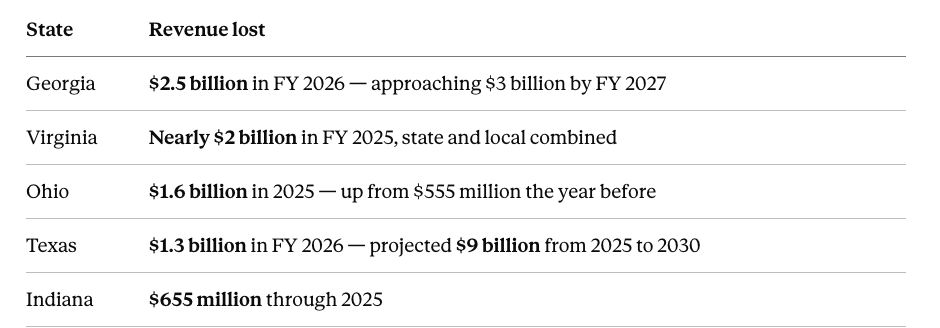
On top of the bill, there's the tax break. At least 32 states have tax incentive programs built specifically for data centers. As of June 2026, 14 of the states with these exemptions still don't publish what they cost.
What states have given away, by their own accounting:
The exemptions are uncapped, often last for decades, and in six states run indefinitely.
That is public money for schools, clinics, and roads, handed to some of the most profitable corporations in human history.
BUILT TO BE THROWN AWAY
The chips inside an AI data center lose their economic value in about three years, according to Research Affiliates, even though the tech giants book them over five to six.
Here is the part they don't advertise: these sales-tax exemptions typically cover replacement servers too. Every time the machines are thrown out and replaced, the new ones are bought tax-free again. The three-year cycle is the deal, the community's exemption, spent over and over, for as long as the building stands.
The chips turn over. The building stays. The tax break stays. The bill stays. The hum stays.
And the footprint spreads. U.S. industrial construction is up 18% year over year, driven in part by warehouses built to stage servers and cooling equipment near data center corridors.
MarketScale / Cushman & Wakefield
WHAT AI RACE?
The line never changes: pause a single data center and America "loses the AI race" to China. That line has been used to justify tax breaks, to skip public hearings, and in Memphis, to ask a federal court to throw out a Black community's pollution lawsuit in the name of national security.
So look at the race they say we're running.
Money didn't decide it. In 2025, U.S. private investment in AI was $285.9 billion. China's was $12.4 billion, twenty-three times less, though Stanford notes China's state funding doesn't show up fully in that figure. By March 2026, the best Chinese model trailed the best American model by just 2.7% on the most widely used public leaderboard. In May 2023 the gap was 17 to 31 points. The United States still holds the top spot, narrowly. Twenty-three times the money bought a lead of less than three percent.
Stanford AI Index 2026, via The Next Web · Stanford HAI
Open source already went the other way. The models the world's developers actually download and build on are increasingly Chinese. Alibaba's Qwen models have 151,448 derivatives on Hugging Face — 2.6 times Meta's entire footprint — and roughly five times Llama's monthly downloads for running AI locally.
Underwater data centers — built there, shelved here. Microsoft tested one. Its sealed servers on the seafloor failed at about one-eighth the rate of servers on land, 6 of 855, against 8 of 135. Then Microsoft shelved the project in 2024.
Data Center Dynamics China took the idea commercial: a pilot off Hainan from 2023, and in February 2026 a 24-megawatt underwater data center off Shanghai powered directly by offshore wind, which its developers say uses no fresh water and more than 90% less land.
Those are the builders' own claims, and the effects on marine life are still understudied — this is not a model to romanticize either.
So which race are we losing? Not the one decided by spending, and not the one decided by building. The United States spent the most and built the most, and the gap closed anyway. The evidence points away from "put more data centers next to Black and Latino neighborhoods" and toward doing more with less, which is exactly what the tax breaks don't pay for.
This isn't a case for China winning. It's a case against the race itself. A race turns land, water, and neighborhoods into a track for other people's competition. The communities in Elyria-Swansea, South Memphis, and Grant County aren't running in it. They're what it's being run over.
Pausing a data center in Elyria-Swansea doesn't hand anything to Beijing. It hands a neighborhood back its air.
WHAT WE DO
1. Find the one near you. Open the tracker. Look up your county. Check the Resistance tab for who's already organizing.
2. Show up at your utility commission. Who pays for the power plants and transmission lines built for data centers is decided in rate cases at your state public utility commission, not in Congress. Show up. Submit comments. Ask two questions on the record: Who is paying for the new infrastructure? Is the data center's contract public?
3. Show up where it's permitted and demand a hearing where there isn't one.
Data centers are won and lost at county zoning boards and state permit hearings. Where zoning lets staff approve them with no public meeting, as in Aurora, the fight is to change the zoning code. Denver's moratorium happened because Elyria-Swansea residents showed up. When the tracker launched in April 2026, 40 projects nationwide had already been cancelled and 45 suspended. Local resistance works.
4. Demand the number. Ask your county and your state, in writing, what they gave away in tax breaks. If they won't publish it, make that the story.
5. Stand with Memphis. Earthjustice and the Southern Environmental Law Center are fighting alongside the NAACP. Follow the case. Share it.
6. Refuse the word "cloud." Every time someone says it, name the land, the air, the bill, and the neighbors underneath it.